
Images
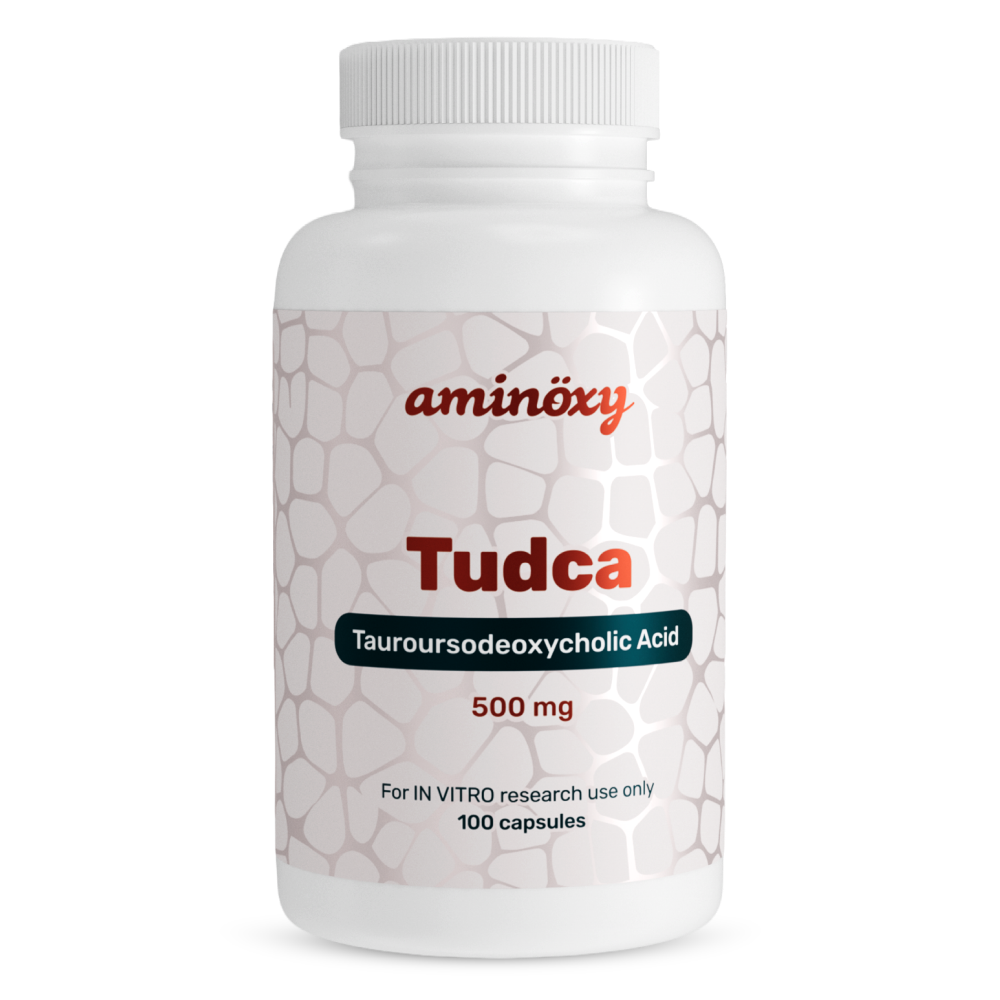
TUDCA
-
Rating
-
0 reviews
-
Brand
-
Aminoxy
-
Availability
-
When a cell comes under pressure, energy alone is not enough. It must maintain order among its proteins, keep its mitochondria stable and retain control over the processes that determine how it continues to function. This is where TUDCA becomes particularly interesting.
Aminoxy TUDCA contains 500 mg of tauroursodeoxycholic acid per capsule. One precisely defined active substance, multiple avenues of research and potential spanning everything from cellular stress to mechanisms associated with cellular resilience and the restoration of balance.
41,31 €
WHAT MAKES TUDCA INTERESTING FOR RESEARCH?
A BILE ACID THAT STANDS OUT FROM THE CROWD
TUDCA (CAS 14605-22-2), short for tauroursodeoxycholic acid, is a bile acid conjugated with taurine. It may sound unassuming, but its research profile is anything but.
Scientists study it primarily in connection with cellular stress, the accumulation of misfolded proteins, mitochondrial stability and signals leading to cell death.
WHEN PROTEINS DO NOT FOLD AS PLANNED
Producing a protein is not enough. To perform its role within the cell, it must fold into the correct shape – a little like origami. If this process goes wrong and misfolded proteins begin to accumulate, the cell comes under increasing pressure.
This is precisely where TUDCA attracts attention. In research, it is often described as a chemical chaperone – in simple terms, a molecular helper studied in connection with correct protein folding and maintaining order within the cell. Scientists are also interested in its relationship with mitochondria, the cell’s “powerhouses”, and with the processes that determine whether a cell restores its balance or progresses towards cell death.
WHY HAS TUDCA ALSO ATTRACTED ATTENTION AMONG BODYBUILDERS?
Bodybuilding is not only about performance and muscle growth. During demanding cycles, attention often also turns to how liver cells, mitochondria and other intracellular systems cope with increased strain. This is precisely why TUDCA has attracted attention among bodybuilders and biohackers.
Its appeal does not lie in being another performance-enhancing substance, but in being a molecule studied in connection with cellular stress, bile acids and mechanisms associated with maintaining cellular balance. That is also why it features so prominently in discussions surrounding cycles and periods of increased strain.
A STORY THAT IS STILL BEING WRITTEN
At first glance, the acronym TUDCA may sound like a product of modern science. Its story, however, stretches back centuries to traditional Asian medicine, where bear bile was used as a natural source of bile acids, including TUDCA.
An important scientific milestone came in 1902, when a previously unknown bile acid was identified in polar bear bile. A quarter of a century later, the Japanese researcher Shoda isolated it and named it UDCA. TUDCA is the form of UDCA conjugated with taurine – and the name itself offers a small clue: “tauro” refers to taurine, while “urso” comes from the Latin ursus, meaning bear.
From centuries-old tradition and the first chemical discoveries to today’s research models, TUDCA has travelled a remarkable path. A molecule whose origins reach deep into the past is now raising entirely new research questions – and that is where its next chapter begins.
FUTURE POTENTIAL
With TUDCA, scientists are not interested in how to “rev up” cells. They are exploring the opposite question: can it help cells maintain order when damaged proteins begin to accumulate, mitochondria no longer function as they should and the pressure gradually increases?
If further research provides convincing answers, it could help us better understand how cells cope with stress and what changes within them as nerve cells gradually become damaged or energy processing is disrupted. Figuratively speaking, scientists are looking at TUDCA as a potential “cellular bodyguard” – a molecule that could help keep things under control when processes within the cell begin to go wrong.
IMPORTANT INFORMATION
This product is not intended for internal use. It is classified as a chemical substance for professional IN VITRO use. Wear protective gloves and protective clothing when handling. Keep out of reach of children.
FAQ
1. What is the difference between TUDCA and UDCA?
UDCA stands for ursodeoxycholic acid. TUDCA is its taurine-conjugated form. They are therefore two related but separately defined chemical substances.
2. What exactly does IN VITRO mean?
IN VITRO means that the product is intended for research outside a living organism under controlled conditions. It is therefore intended exclusively for researchers and biohackers.
3. Can the results of IN VITRO research be automatically applied to humans?
No. Results obtained from cells or other experimental models may reveal interesting directions for further research, but they do not automatically confirm the same effects in the human body.
4. Why does an IN VITRO product come in capsule form?
In this case, the capsule serves as a practical reference unit containing a precisely stated amount of the substance. One capsule contains 500 mg of TUDCA. This is not a recommended dosage for internal use.
5. Does the product contain any other ingredients?
In addition to TUDCA, the product contains microcrystalline cellulose, magnesium stearate and an HPMC capsule.
6. How should Aminoxy TUDCA be stored?
Keep the product in a tightly closed container in a cool, dry place, away from direct sunlight and moisture, and out of reach of children.
SOURCES
PubChem – Tauroursodeoxycholic acid
PMID 31757001 – TUDCA as a bile acid with chaperone activity
PMID 11206313 – history of the discovery and isolation of UDCA
PMID 28630443 – TUDCA, protein aggregation and cellular stress
PMID 12198651 – TUDCA and endoplasmic reticulum stress
PMID 12627974 – TUDCA, the mitochondrial membrane and cytochrome c
PMID 33636170 – TUDCA and neurodegenerative research models
PMID 39661468 – a more recent perspective on the mechanism of TUDCA in acute ER stress