


Muscle growth isn’t something you can switch on like a mobile app, and simply exercising more often isn’t enough on its own. If you’re looking for ways to speed up muscle growth or achieve rapid muscle growth, the results depend on a combination of training, diet, carefully chosen supplements and recovery. Let’s take a look at which of these factors is most important – and which is more of a marketing claim on the label.
What is needed for muscle growth?
Muscles need a reason to adapt and the right conditions in which to do so. Regular strength training creates the load, sufficient energy and protein provide the body with the building blocks, and recovery gives it time to rebuild.
So, there are three key elements:
Training stimulus: you gradually increase the load on your muscles, giving them a reason to grow stronger.
Sufficient energy and nutrients: the body needs fuel as well as protein to repair and build muscle tissue.
Rest: without it, fatigue builds up and performance may start to decline rather than improve.
No single thing can work miracles on its own. Even a post-workout protein shake won’t make up for a chaotic diet and unplanned training in the long run. On the other hand, you don’t need to have a perfect routine from day one. A manageable plan that you can stick to for months on end will be more helpful.
Foods for muscle growth
When looking for foods to promote muscle growth, there’s no need to search for a single ‘miracle’ ingredient. It’s far more important to ensure you consume enough energy throughout the day and regularly include high-quality sources of protein, carbohydrates and fats.
Protein can be found, for example, in meat, fish, eggs, dairy products, tofu, pulses and seitan. They help the body meet its need for amino acids for the repair and synthesis of muscle proteins. A large meta-analysis of training studies found that protein supplementation can support gains in muscle mass and strength; however, the average additional benefit did not increase significantly beyond a total daily intake of around 1.6 grams per kilogram of body weight. This is a guideline, not a mandatory standard for everyone. See the summary of this meta-analysis.
Carbohydrates provide energy for training. Practical sources include rice, potatoes, oat flakes, wholemeal bread, fruit and pulses. If you’re low on energy before a workout, the problem may not be a lack of another stimulant – sometimes you’ve simply not eaten enough.
You shouldn’t cut outfats. Olive oil, nuts, seeds, avocados and oily fish add important nutrients and energy to your diet.
A simple meal might look something like this: rice or potatoes, a source of protein, vegetables and a little fat. Every meal doesn’t have to look like a photo from a fitness magazine. It matters far more that you eat similarly balanced meals on a regular basis.
A slight calorie surplus can help with muscle building, but research has not identified a precise figure that applies to everyone. An overview of calorie surplus and muscle hypertrophy points out that there isn’t enough data to establish a universal amount of extra energy. A large calorie surplus doesn’t guarantee faster muscle growth; often, it simply accelerates fat gain as well. It makes more sense to monitor your weight, training performance and how you feel, and to adjust your diet gradually.
We discuss practical options for pre-workout meals in more detail in the article What to eat and take before a workout: diet vs. supplements.

A training plan for muscle growth
A good training plan for muscle growth doesn’t have to be complicated. It should allow you to regularly work out the main muscle groups, gradually increase the intensity, whilst still allowing time for recovery. You don’t need to change all your exercises every week, nor do you need to leave the gym feeling as though you’ve just been run over by a lorry.
Focus primarily on these principles:
Consistency: choose a schedule that you know you can stick to in the long term.
Gradual increase in load: over time, add more repetitions, slightly increase the weight, or perform the same exercise with better technique.
Sufficient volume: your muscles need an appropriate number of working sets, not endless exercise.
Good technique: a repetition only counts if you perform it in a controlled manner, not if the barbell just manages to get through the last few centimetres.
A meta-analysis of training studies found a link between a higher weekly volume of strength training and greater muscle growth. However, this does not mean ‘the more, the better’ without limits. If you’re adding sets, keep an eye on your performance and recovery too. The findings of the study on training volume support a gradual, manageable increase in load – not a reckless piling on of work.
Whether you prefer full-body training or splitting your workouts by muscle group depends on your time, experience and how well you recover after exercise. It helps to keep a record of the exercises, sets, repetitions and weights used. This allows you to see whether you’re actually making progress, or simply repeating the same workout in the hope that your muscles will take notice.
If you’re performing the exercises with good technique, try adding one repetition or increasing the weight slightly. You don’t need to do this every session or change everything at once. If your performance drops over several sessions in a row, first take a look at your sleep, diet and rest. An occasional poor session is to be expected. What matters is whether you’re gradually improving.

The best supplements for muscle growth
The best supplements for muscle growth are those that address a specific need. A supplement can help with nutrient intake or support your performance, but it won’t do a single set for you.
Protein powder is a practical way to top up your protein intake when you can’t get enough from your diet. If you’re getting enough from your diet, an extra shake isn’t a must.
Creatine is one of the best-researched sports supplements. It can support performance during repeated short, intense bursts of effort, such as strength training. A meta-analysis, which also looked at direct measurements of muscle hypertrophy, found a small additional benefit when creatine was combined with resistance training. See the results.
EAAs are essential amino acids that the body cannot produce itself. They may be useful in certain situations, but if you consume sufficient amounts of complete proteins from food or protein supplements, they may not provide any significant additional benefit.
HMB is a substance marketed primarily for its purported ability to support muscle growth and recovery. However, the evidence is not as convincing as that for creatine: a meta-analysis of healthy adults aged 18 to 45 found no evidence that HMB improved changes in muscle mass or strength during strength training. Summary of research on HMB.
If you’re just starting out, it’s usually worth sorting out your training and diet first. Only then does it make sense to consider which supplement will actually help you with a specific goal – such as increasing your protein intake or taking creatine regularly.
Nutritional supplements for muscle growth: which ones are worth it?
Choosemuscle-building supplements based on what’s missing from your routine. Before buying, ask yourself three questions:
What specific problem is the product designed to address?
Is there reasonable scientific evidence to support its effectiveness?
Do I understand the ingredients and what the product is intended for?
If you want to incorporate creatine into your training routine as part of a sophisticated blend, CREATINE MONSTER MIX combines five forms of creatine: creatine monohydrate, creatine nitrate, Kre-Alkalyn®, magnesium creatine chelate and creatine HCl. A single serving contains a total of 6,000 mg of creatine complex, supplemented with minerals and electrolytes. The blend is caffeine-free, so it will also be appreciated by those who wish to avoid caffeine.
If you’d like to have more training products in a single pack, the STARTER GYM PACK combines Warrior CREA PUMP, BCAA Amino Powder and EPI CAT. Each has its own unique formulation and purpose, but you’ll find them all together in this pack – a practical option for those who want to simplify their choice of training products.
You’ll find both products in the Muscle Building category, where you can also explore other options to suit your needs.
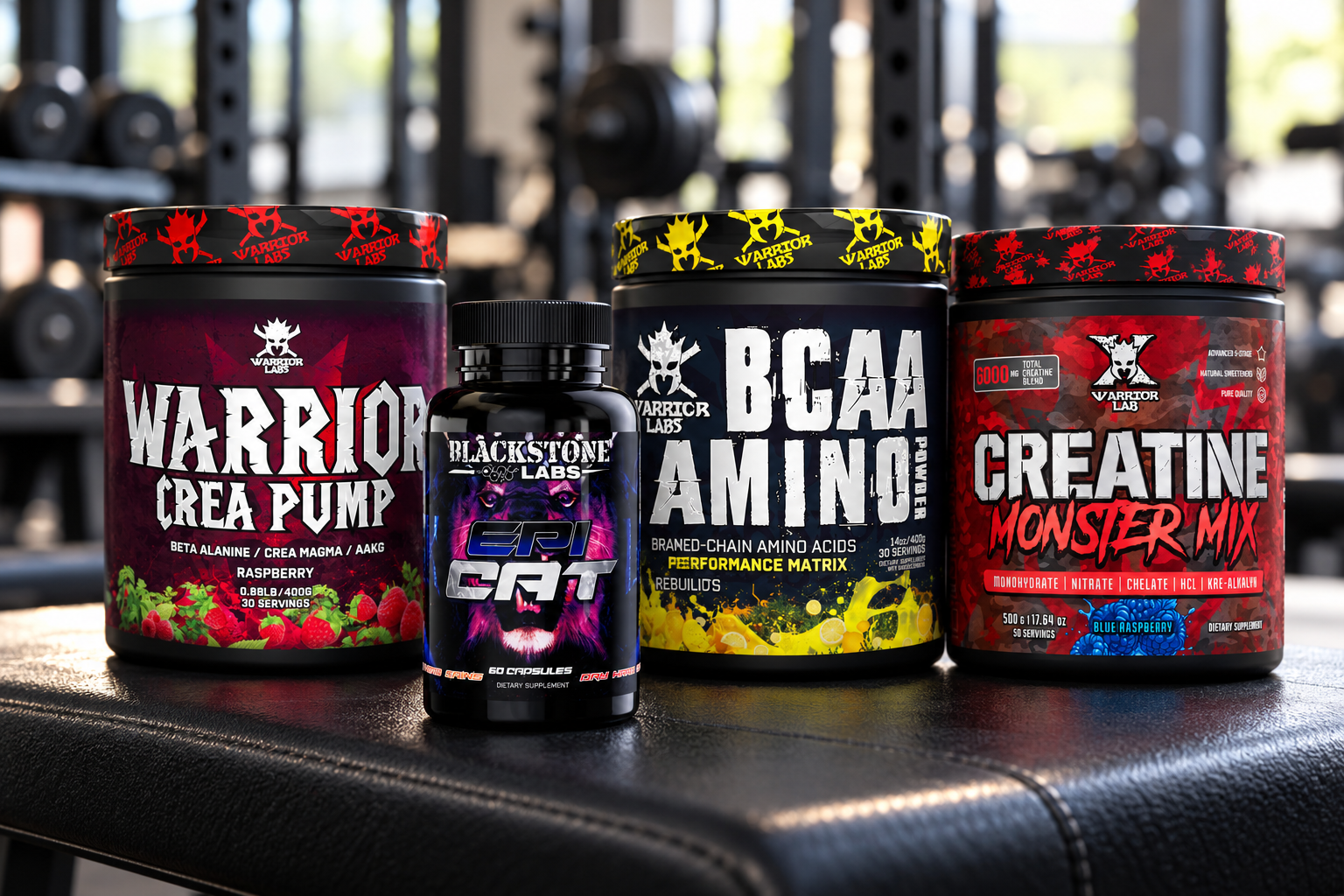
When it comes to supplements, be wary of exaggerated claims such as ‘effortless muscle growth’ or ‘results in a few days’. If muscle growth could be reliably guaranteed by a single dose, trainers would have a much easier time of it. You can find out more about how to distinguish between proven options and marketing hype in the article Steroid alternatives: which ones make sense?.
Recovery and muscle growth
Training puts strain on your muscles; the rest of your routine helps them prepare for the next session. That is why recovery and muscle growth complement each other. If you train intensively but sleep too little, eat irregularly and skip rest periods, further sets may not lead to further progress.
Recovery is supported in particular by:
sufficient sleep and a relatively consistent routine,
a rest day or a lighter training session, depending on the intensity of your programme,
food and fluids appropriate to your training,
adjusting the training load if your performance continues to decline or fatigue builds up.
Fatigue after a demanding training session is common. However, if it occurs repeatedly even before you start exercising, do not automatically reach for another dose of stimulants. Check your sleep, diet and overall workload. If you’re interested in the causes of pre-workout fatigue and ways to get energised without overloading on stimulants, read the article Pre-workout fatigue: how to get energised without overtraining.
What’s best for muscle growth?
If you’re wondering what’s best for muscle growth, don’t start by looking for a single product. It makes the most sense to follow this sequence:
strength training → sufficient energy and protein → gradually increasing the load → recovery → a suitably chosen supplement
It is precisely the combination of these steps that gives the body a repeated reason to get stronger, whilst also providing the conditions for recovery. Supplements can help with specific needs, but they do not play the same role or have the same effect as training, food and sleep. And if progress slows down, the first question needn’t be ‘what else should I buy?’, but rather ‘which parts of my plan can I do more regularly?’
Sources
Morton RW et al. Protein supplementation and resistance training-induced gains in muscle mass and strength: systematic review and meta-analysis, 2018.
Schoenfeld BJ et al. Dose-response relationship between weekly resistance training volume and increases in muscle mass, 2017.
Slater GJ et al. Is an Energy Surplus Required to Maximize Skeletal Muscle Hypertrophy Associated With Resistance Training?, 2019.
Burke R et al. Creatine supplementation combined with resistance training and muscle hypertrophy: systematic review and meta-analysis, 2023.
Jakubowski JS et al. HMB and resistance exercise-induced changes in body composition or strength: systematic review and meta-analysis, 2020.