

Did you know that most recreational athletes show up to their workouts without any pre-workout nutritional preparation? Yet, the question of what to eat before a workout is crucial. Research from the International Society of Sports Nutrition confirms that the proper timing of nutrient intake can significantly affect recovery, muscle protein synthesis, and overall training performance.
In the previous article, Pre-workout supplements: usage, timing, and safe combinations, we introduced the topic of pre-workout supplements. Now we will look at the bigger picture – the practical differences between regular whole foods and dietary supplements in the context of pre-workout nutrition. You will also learn what to eat before a workout for weight loss, how to fuel up before a morning workout, and why hydration is not just about water.
What to eat and what to take before a workout
Pre-workout diet vs. supplements
The foundation of performance in any physical activity is an adequate energy supply. This energy primarily comes from glycogen – a form of carbohydrates stored in the liver and muscles.
📊 Glycogen in numbers:
💪 Glycogen depletion:
⏱️ Glycogen recovery:
|
Complex vs. simple carbohydrates
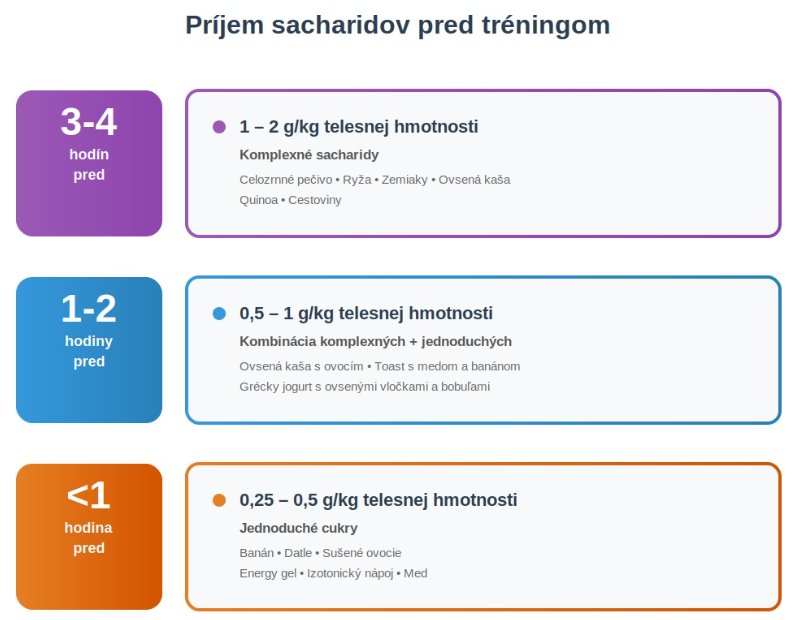
What type of carbohydrates should you have before a workout? It should depend on the time remaining until your workout.
Full meal (2-4 hours before)
A meal containing complex carbohydrates, proteins, and fats digests gradually and supplies energy continuously over several hours. The body needs time for digestion – therefore, it is ideal to eat such a meal 2-4 hours before a workout.
Complex carbohydrates (oatmeal, whole-grain bread, rice, sweet potatoes, legumes) are the best choice within this time window. They digest gradually, provide stable energy, and minimize the risk of digestive issues during exercise.
Quick solution (15-45 minutes before)
Simple carbohydrates (banana, honey, dates, sports drinks) are absorbed quickly and provide an immediate spike in blood glucose. They are ideal when you don't have time to wait or need a quick energy boost.
Created using Claude AI (Anthropic)
💡 What about fats? Have a meal high in fats at least 4-5 hours before your workout. If you have less time, keep your fat intake under 10-15 g. This is because fats slow down digestion and delay the absorption of carbohydrates. |
When to choose food, when to choose supplements
Dietary supplements offer faster absorption and specific effects. A protein shake is absorbed in 60–90 minutes, and simple carbohydrates even faster. Supplements are practical when you do not have time for a full meal or when you need a precisely timed intake of specific nutrients.
💡 Tip: For those looking for high-quality protein support before a workout, you can find proven solutions in the aminoxy.com e-shop:
|
When to choose food:
You have 2–4 hours before your workout.
You prefer stable energy during a longer workout.
You want to optimally replenish your glycogen stores.
When to choose supplements:
You have less than 1–2 hours before your workout.
You need quick energy without burdening your digestion.
You train in the morning and do not have the time/appetite to eat.
You can read more about pre-workout supplements and their timing in the article: Pre-workout supplements: usage, timing, and safe combinations.
The ideal combination for most gym-goers: A full meal 3–4 hours before the workout + a smaller snack or shake 30–60 minutes before starting. This strategy ensures both adequate glycogen stores and the immediate availability of amino acids.
💡 Interesting fact: Studies show that nutrient timing is more important for advanced athletes than for beginners and can significantly impact results. Beginners benefit from training even without precise meal timing. |
The Difference Between Cardio and Strength Training
Different types of workouts have different energy demands and, therefore, different requirements for pre-workout nutrition.
Cardio Training
We divide cardio into two basic types. Energy demands differ dramatically based on intensity:
HIIT (High-Intensity Interval Training)
Short bursts of maximum intensity (e.g., sprints, burpees, box jumps).
High dependence on glycogen, similar to strength training.
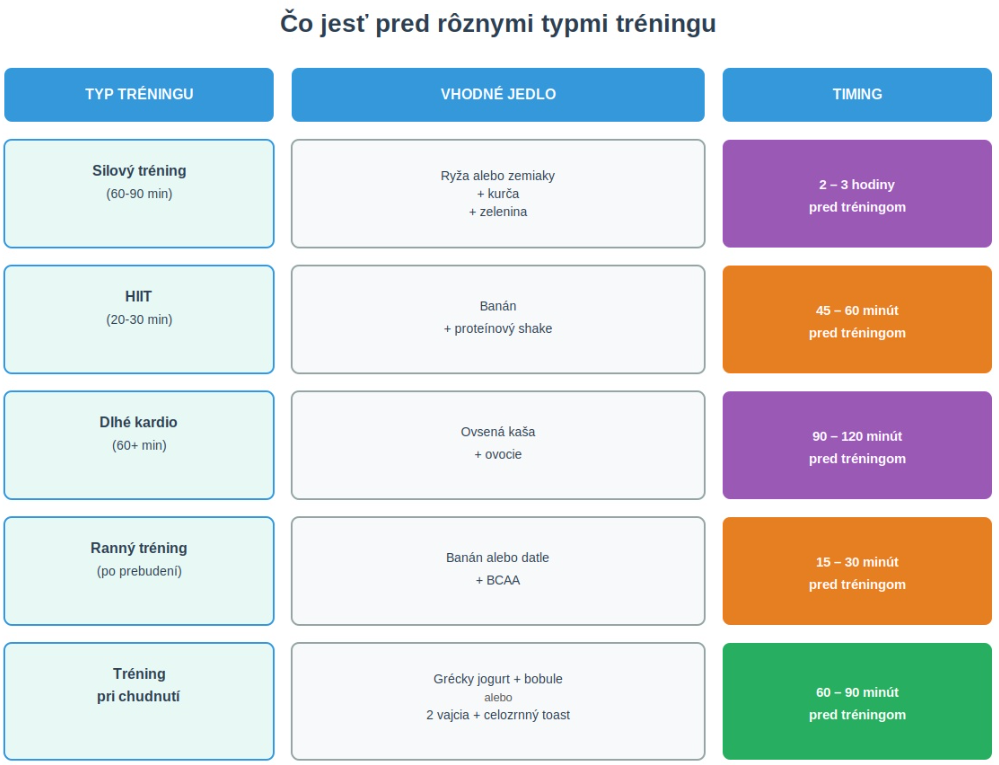
Recommendation: Carbohydrates are crucial. If you have time, eat a full meal 2-3 hours beforehand (rice with chicken, oatmeal). If you work out in the morning and are in a hurry, opt for a combination of a banana + a protein shake 30 minutes before, or a few dates + BCAAs.
LISS (Low-Intensity Steady State Cardio)
Longer activity at a lower intensity (walking, light jogging, cycling).
The body uses fats as fuel more efficiently.
Recommendation: A smaller volume of food; prefer easily digestible foods (less fat and fiber). White yogurt with honey, a few biscuits, rice cakes, or a banana are suitable options. It is possible to work out on an empty stomach.
Strength Training
Strength training primarily utilizes anaerobic metabolism (i.e., generating energy without oxygen) and typically lasts 45–90 minutes. The primary energy source is glycogen.
Recommendation: A full meal 2-3 hours before the workout with an emphasis on carbohydrates and proteins (e.g., rice/potatoes + chicken + vegetables). If you train in the morning and are in a hurry: oatmeal with a banana 60-90 minutes before, or a protein shake + a banana 30 minutes before.
What to eat before a workout for weight loss
Training in a caloric deficit has its specifics. When calorie intake is lower than expenditure, the body must manage energy more efficiently. However, this does not mean you should starve before a workout – quite the opposite. Strategically placing calories around your workout time can preserve both performance and muscle mass.
Protein remains the priority. ISSN research recommends an intake of 1.6–2.2 g of protein per kg of body weight daily to preserve muscle mass during weight loss. Before a workout, it is advisable to include 20–40 g of high-quality protein, ideally 2–3 hours before the exertion. Protein ensures an adequate supply of amino acids for the muscles while also helping to maintain a feeling of satiety.

Strategic carbohydrates. When losing weight, you don't have to eliminate carbohydrates completely – just eat them when the body needs them most. An intake of 0.5–1 g of carbohydrates per kg of body weight before a workout will provide enough energy for intense work, but without an unnecessary caloric surplus.
Fasted cardio – a topic that divides the fitness community. A meta-analysis of 27 studies published in the British Journal of Nutrition confirmed that exercising on an empty stomach indeed increases fat oxidation (i.e., fat burning) during the activity itself.
But beware – long-term studies have not proven that this leads to greater overall body fat loss. Why? The body balances the difference out during the rest of the day. If you burn more fat in the morning on an empty stomach, the body burns less in the afternoon and evening.
A separate question is the glycemic index of the pre-workout meal. A meta-analysis of 19 studies published in the Journal of the International Society of Sports Nutrition (2017) found no clear benefit of low-glycemic-index meals for endurance performance if carbohydrates were consumed during exercise. In practice, this means: if you drink a sports drink during a longer workout, the glycemic index of your pre-workout meal is of lesser importance.
What to Eat Before a Morning Workout
A morning workout presents a specific challenge: after 8–10 hours of sleep, the glycogen stores in the liver are partially depleted, and your stomach is empty. At the same time, you have limited time and perhaps zero appetite right after waking up.
Quick options for those in a hurry:
Banana – a quick source of carbohydrates, easily digestible, contains potassium.
2–3 dates – concentrated energy, natural sugars.
Rice cakes with honey – quick carbohydrates, minimal digestive load.
Protein shake – if you don't have time for solid food, the liquid form absorbs faster.
Breakfast before a workout (if you have a gap of at least 60–90 minutes):
Oatmeal with a banana – complex carbohydrates + quick sugars.
Toast with peanut butter and honey – carbohydrates + fats + proteins.
Fruit and protein powder smoothie – liquid form, quick digestion.
Training completely fasted can work for low-intensity cardio or for shorter workouts under 45 minutes. However, for strength training or high-intensity HIIT, at least a minimal intake of carbohydrates is recommended, because these activities are highly dependent on glycogen.
Hydration and Electrolytes
Inadequate hydration is a silent killer of performance. Research consistently shows that a fluid loss equivalent to just 2% of body weight reduces endurance performance by 10–20%. In strength training, dehydration reduces strength by approximately 2%, performance by 3%, and high-intensity endurance by up to 10%.
The mechanism is complex: dehydration reduces plasma volume, increases blood viscosity (thickness), reduces the amount of blood returning to the heart, and ultimately decreases cardiac output. The muscles receive less oxygen and nutrients, and thermoregulation is impaired.
How much to drink:
2–3 hours before a workout: 400–600 ml of water
10–20 minutes before a workout: 200–300 ml
During the workout: 150–350 ml every 15–20 minutes
After the workout: Replace 150% of the lost weight (weigh yourself before and after the workout – if you lost 1 kg, drink 1.5 l). For recreational athletes, the rule of thumb is: drink 500-800 ml for every 60 minutes of intense training.
Electrolytes – sodium, potassium, magnesium, calcium – are important for neuromuscular function, fluid retention, and cramp prevention. For workouts up to 60 minutes in normal conditions, plain water is usually sufficient. For longer workouts, heavy sweating, or exercising in the heat, an electrolyte drink is recommended.
💡 During long cardio (60+ minutes) at high intensity, you need to replenish carbohydrates directly during the exercise. How do you recognize high intensity? You are out of breath and unable to hold a continuous conversation. Technically, this is called an intensity above 70% of VO2max (the body's maximum ability to utilize oxygen). The ISSN recommends an intake of 30-60 g of carbohydrates per hour of exercise, preferably in the form of a sports drink (a 6-8% carbohydrate-electrolyte solution). |
Coconut water is often presented as a natural alternative to sports drinks. It contains approximately 600 mg of potassium per cup, which is more than in most sports drinks. A study published in the Journal of the International Society of Sports Nutrition compared coconut water with a standard sports drink and plain water – all three beverages rehydrated the body equally effectively.
However – coconut water contains less sodium, which is the main electrolyte lost through sweat. For intense or long workouts, add a pinch of salt to your coconut water or opt for a traditional sports drink.
Summary: What to Eat Before a Workout
Key Takeaways:
Plan ahead: A full meal 2-4 hours before a workout provides stable energy.
Adapt to the situation: If you are short on time, quick carbohydrates and a protein shake will help.
Do not underestimate hydration: Even a 2% dehydration significantly reduces performance. Do not forget to replenish electrolytes.
Losing weight does not mean starving: A strategic intake of proteins and carbohydrates will save both your performance and your muscles.
Created using Claude AI (Anthropic)
Read also:
Pre-workout supplements: usage, timing, and safe combinations
Fatigue before a workout: how to get energized without unnecessary overload
Peptides: what they are, how they work, and what scientific research says
Sources
Kerksick CM, Arent S, Schoenfeld BJ, et al. "International society of sports nutrition position stand: nutrient timing" - Journal of the International Society of Sports Nutrition, 2017
Jäger R, Kerksick CM, Campbell BI, et al. "International Society of Sports Nutrition Position Stand: protein and exercise" - Journal of the International Society of Sports Nutrition, 2017
Vieira AF, Costa RR, Macedo RCO, et al. "Effects of aerobic exercise performed in fasted v. fed state on fat and carbohydrate metabolism in adults: a systematic review and meta-analysis" - British Journal of Nutrition, 2016
Cheuvront SN, Kenefick RW. "Dehydration: physiology, assessment, and performance effects" - Comprehensive Physiology, 2014
Judelson DA, Maresh CM, Anderson JM, et al. "Hydration and muscular performance: does fluid balance affect strength, power and high-intensity endurance?" - Sports Medicine, 2007
Kalman DS, Feldman S, Krieger DR, Bloomer RJ. "Comparison of coconut water and a carbohydrate-electrolyte sport drink on measures of hydration and physical performance in exercise-trained men" - Journal of the International Society of Sports Nutrition, 2012
Thomas DT, Erdman KA, Burke LM. "American College of Sports Medicine Joint Position Statement. Nutrition and Athletic Performance" - Medicine and Science in Sports and Exercise, 2016
Moro T, Tinsley G, Bianco A, et al. "Effects of eight weeks of time-restricted feeding (16/8) on basal metabolism, maximal strength, body composition, inflammation, and cardiovascular risk factors in resistance-trained males" - Journal of Translational Medicine, 2016
Schoenfeld BJ, Aragon AA, Wilborn CD, et al. "Body composition changes associated with fasted versus non-fasted aerobic exercise" - Journal of the International Society of Sports Nutrition, 2014
Heung-Sang Wong S, Sun FH, Chen YJ, Li C, Zhang YJ, Ya-Jun Huang W. "Effect of pre-exercise carbohydrate diets with high vs low glycemic index on exercise performance: a meta-analysis" - Journal of the International Society of Sports Nutrition, 2017