

The global market for pre-workout supplements exceeds $20 billion. Approximately 30% of new fitness center members reach for these products within their first month of working out. What is a pre-workout, and where does their popularity stem from? It lies in their ability to boost energy, focus, and performance — all in a single dose.
In this article, you will learn what to take before a workout, what ingredients these products contain, and how to properly time their consumption. Whether you train in the morning or in the evening, this article will help you navigate pre-workout supplements and utilize their full potential.
What is a pre-workout and how does it work
What is a pre-workout and who is it intended for?
We call them pre-workouts, pre-workout stimulants, or pump supplements. This category of dietary supplements is taken before physical activity and is primarily intended for:
Strength athletes and bodybuilders – they support muscle pump, strength, and performance when lifting weights.
Fitness enthusiasts – they help overcome fatigue and increase workout intensity.
Combat sports athletes (MMA, boxing, kickboxing, BJJ) – they improve reaction time, focus, and explosiveness.
Endurance athletes – they can support performance during prolonged activities if dosed correctly.
The basic mechanism of action can be divided into three main categories:
Central nervous system (CNS) stimulation – provides a rapid increase in energy and better focus.
Vasodilation – which means the widening of blood vessels.
Cognitive enhancement – supports the so-called "mind-muscle connection," which is the ability to better feel and control the working muscle during an exercise.
💡 A pre-workout is not an "upgraded energy drink." A standard energy drink contains approximately 80 mg of caffeine and a lot of sugar. A high-quality pre-workout can contain 200–400 mg of caffeine, plus other active ingredients for the pump and focus, but without unnecessary sugars. |

Most Common Pre-Workout Ingredients
So, what supplements should you take before a workout? It depends on their composition and the effect you want to achieve. Pre-workouts contain a combination of substances from multiple categories, with each fulfilling a specific function:
Stimulants (energy and focus): This includes the most well-known and researched stimulant – caffeine, but also DMHA and DMAA (synthetic substances with an adrenaline-like effect that significantly increase energy and focus). They activate the nervous system, provide a rapid energy boost, improve alertness, and reduce the perception of fatigue during training.
Vasodilators (pump and blood flow): Citrulline malate, arginine AKG, and agmatine sulfate support the production of nitric oxide (NO) in the body. Nitric oxide widens blood vessels, thereby increasing blood flow to the working muscles. The result is better delivery of oxygen and nutrients, as well as the characteristic feeling of a muscle pump – tension and engorgement of the muscle with blood.
Cognitive enhancers (focus): Alpha GPC, Huperzine A, DMAE, and N-Acetyl L-Tyrosine support the production and function of chemicals in the brain responsible for concentration and the transmission of nerve signals. Thanks to this, they can improve focus, reaction time, and coordination during a workout.
Performance ingredients: Beta-alanine increases the level of carnosine in the muscles. Carnosine helps maintain a stable internal environment in the muscle during intense exercise and delays the feeling of "burning" and fatigue. Taurine supports cellular hydration and neuromuscular function. Creatine (in various forms) increases the availability of ATP – a molecule that muscles use as an immediate source of energy for short-term, high-intensity performance.
Plant extracts: Kanna (Sceletium tortuosum) can improve mood and reduce pre-workout anxiety. Yohimbe supports fat mobilization.
You can read more about individual substances, their dosing, and scientific research in the article: Pre-workout supplements: BCAAs, arginine, magnesium, caffeine, and more.
The Difference Between Stimulant and Non-Stimulant Pre-Workouts
Choosing the right type of pre-workout is one of the most important decisions when it comes to pre-training supplementation.
Stimulant Pre-Workouts (STIM)
They contain caffeine and stronger stimulants like DMHA or DMAA. The advantage is an immediate boost in energy, focus, and motivation. However, there is a risk of developing a tolerance and experiencing negative effects on sleep if taken later in the day.
💡 With long-term use of stimulant pre-workouts, tolerance can develop — the same dose will stop having such a strong effect. Therefore, an occasional break (1-2 weeks) or alternating with stim-free variants is recommended. |
Non-Stimulant Pre-Workouts (STIM-FREE)
They provide performance benefits without affecting sleep. They are suitable for evening workouts and for people with a sensitivity to caffeine and other stimulants. The disadvantage is the absence of the typical energy "kick" that many gym-goers seek.

Created using Claude AI (Anthropic)
When to Take a Pre-Workout
Timing before strength training
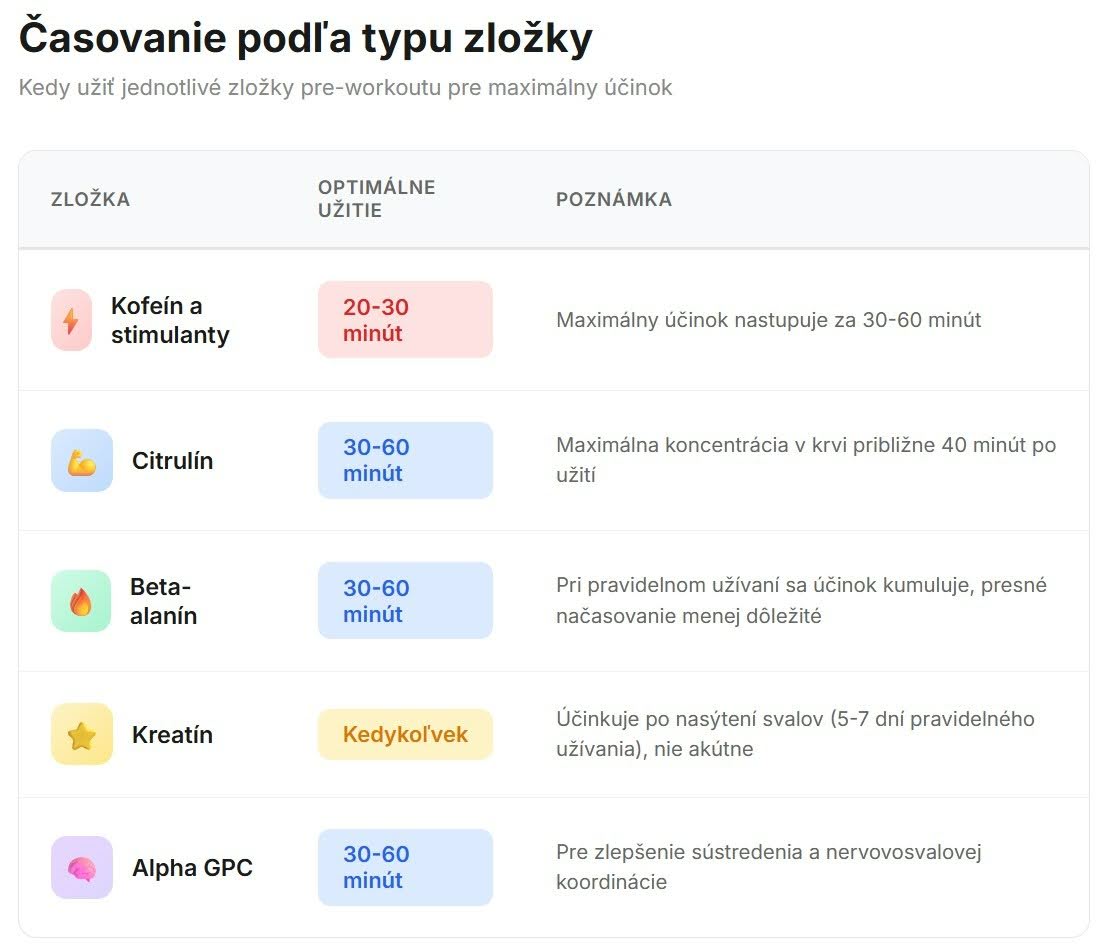
Proper timing is crucial for maximizing the effect of a pre-workout supplement. However, different ingredients have different absorption rates, meaning consumption should be timed accordingly:
Created using Claude AI (Anthropic)
General recommendation: Most pre-workouts are formulated to be taken 20–30 minutes before a workout. This timeframe allows for the absorption of both stimulants and vasodilating agents. Non-stimulant variants focused on the pump can be taken 30–45 minutes in advance so that citrulline and similar substances have time to reach their maximum concentration in the blood.
The effect of food on absorption: Taking it on an empty stomach results in a faster onset of action (15–20 minutes) and a more intense subjective feeling of energy, but it can cause stomach discomfort in some individuals. Taking it after a meal results in a slower onset of action (30–45 minutes) but provides a milder and more stable effect throughout the entire workout.
Pre-Workout Before Cardio Training
Endurance training (running, cycling, swimming, rowing) has different energy demands than strength training. Cardio activities typically last 30–90 minutes and require more stable energy support.
During cardio training, consider lower doses of stimulants – high doses can increase your heart rate above the optimal aerobic zone. Furthermore, in combination with sweating, they increase fluid loss. Non-stimulant substances like citrulline and beta-alanine are much more suitable for endurance activities.
If you are interested in what to eat before different types of workouts, read the next article in this series: What to eat and take before a workout: diet vs. supplements
Pre-workout in the Evening and After 6:00 PM
Evening training requires a different approach to supplementation, especially if the goal is to maintain the quality of sleep and recovery.
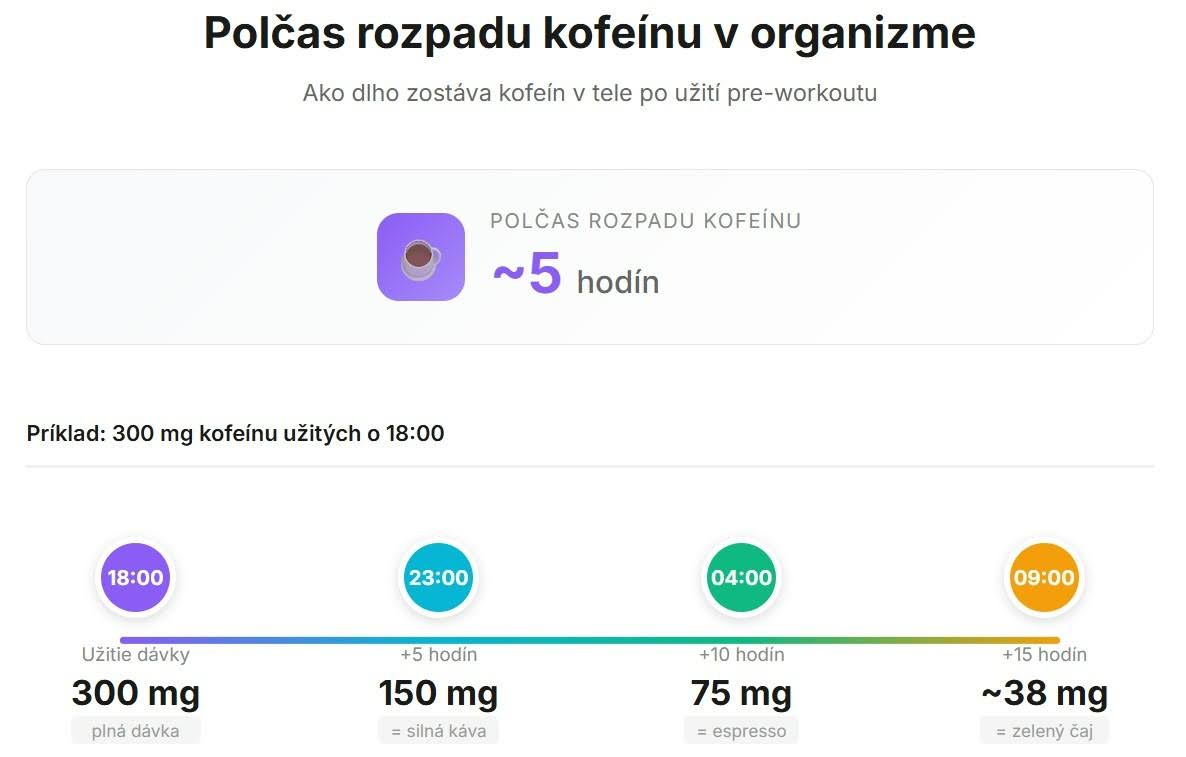
The problem with stimulant pre-workouts: Substances with a stimulant effect have a relatively long lifespan in the body. If we illustrate this with caffeine, its half-life is approximately 5 hours. What does this mean in practice? If you take a pre-workout with 300 mg of caffeine at 6:00 PM, an hour before midnight you still have about half of that amount in your system, which is the equivalent of a double espresso.
A meta-analysis published in Sleep Medicine Reviews (2023) showed that caffeine taken with insufficient time before bedtime shortened sleep by 45 minutes and reduced its efficiency by 7%. Researchers found that the impact on sleep depends on the dose:
Standard coffee (approx. 100 mg of caffeine): The recommended gap is at least 8–9 hours before sleep.
Stronger pre-workouts (200+ mg of caffeine): The recommended gap is up to 12–13 hours.
In practice, this means: If you plan to go to bed at 10:00 PM and your pre-workout contains 200–300 mg of caffeine, the last dose should ideally be taken by 9:00–10:00 AM. For milder doses (100–150 mg), the cutoff time can be 2:00 PM–3:00 PM.
Created using Claude AI (Anthropic)
⚠️ Do not use stimulant pre-workouts containing caffeine, DMHA, or DMAA late in the afternoon or evening. As a safe boundary, we recommend 6–8 hours before planned sleep – in a normal routine, this means approximately until 2:00 PM–4:00 PM. Sleep disruption negatively affects recovery, hormonal balance (including testosterone and growth hormone), and long-term training results. |
The solution for those who work out in the evening – non-stimulant pre-workouts:
Non-stimulant formulas contain substances that do not affect sleep:
Citrulline – supports muscle pump and blood flow without affecting the nervous system.
Beta-alanine – increases muscle endurance.
Creatine – supports strength and performance.
Glycerol – improves muscle hydration.
Tip: For evening training, the caffeine-free night pre-workout Warrior Crea Pump is ideal. It provides a muscle pump and performance benefits without affecting sleep quality.
Unpleasant Side Effect: What is a "Crash" and How to Prevent It
A few hours after taking a stimulant pre-workout and completing a demanding workout, you might experience a feeling of exhaustion, decreased concentration, irritability, or even headaches. In the fitness community, this phenomenon is known as a "crash" – a sudden drop in energy that occurs after the effects of stimulants wear off.
What Causes a Crash
The main cause is the mechanism by which caffeine and other stimulants affect the brain. Caffeine blocks receptors for adenosine – a substance that accumulates in the body during wakefulness and induces a feeling of fatigue. While caffeine blocks these receptors, adenosine continues to be produced and builds up in the background.
When the effect of caffeine wears off (usually 3–5 hours after ingestion), the accumulated adenosine suddenly binds to the freed-up receptors. This phenomenon is called "adenosine rebound" – the brain receives a delayed but amplified signal of fatigue. The result is a sharp drop in energy, which we often feel more intensely than if we had not taken stimulants at all.
Other factors also contribute to the intensity of a crash:
High doses of caffeine (over 200 mg) – the higher the dose, the larger the rebound.
Training on an empty stomach – depletion of glycogen stores without subsequent replenishment.
Dehydration – stimulants have a mild diuretic effect.
Lack of sleep – already elevated adenosine levels before the workout.
Sugar in the pre-workout – a combination of a caffeine crash and a glycemic drop.
💡 Regular caffeine consumers may experience stronger crashes. With chronic use, the body increases the number of adenosine receptors, leading to a larger rebound when the caffeine wears off. |
How to Prevent a Crash
Strategy | Explanation |
Lower dose of stimulants | Start with a half dose; the crash will be less intense. |
Do not take on an empty stomach | Food slows down absorption and mitigates both the sharp onset and the crash. |
Hydration | Maintain fluid intake before, during, and after the workout. |
Post-workout meal | Carbohydrates + protein within 30–60 minutes after training = restoration of energy stores and stabilization of blood sugar levels. |
L-theanine combined with caffeine | This amino acid from green tea smooths out the sharp edges of caffeine and reduces the risk of a crash. |
Cycling stimulants | Regular 1–2 week breaks from stimulant pre-workouts help reset tolerance. |
What to Do When a Crash Occurs
Replenish complex carbohydrates – oatmeal, rice, or whole-grain bread will restore glucose levels.
Hydrate with electrolytes – helps with fatigue caused by a lack of fluids.
Take a short power nap (15–20 minutes) – strictly a short nap, because a longer sleep can make the situation worse.
Go for a walk in the fresh air – mild activity promotes blood flow and helps "get the body moving."
Avoid taking more caffeine – adding another dose will only delay and amplify the problem.
⚠️ Warning: If you experience crashes regularly, consider switching to non-stimulant pre-workouts or reducing the dose. A frequent "stimulant → crash → stimulant" cycle can lead to building a tolerance and the need for increasingly higher doses. |
Summary: How to use pre-workouts correctly
Pre-workouts can be a valuable aid in achieving training goals – if you use them wisely. However, it is not just about what to take before a workout; the key to success is proper timing, choosing the right type according to the time of day, and respecting your own body's needs.
Basic rules for safe use:
Maximum 1 dose per day.
Take stimulant variants at least 6–8 hours before sleep.
Choose non-stimulant alternatives for evening workouts.
If you have health issues, consult a doctor before use.
Stimulants are not intended for persons under 18 years of age.
Read also:
Fatigue before a workout: how to get energized without unnecessary overload
Pre-workout supplements: BCAAs, arginine, magnesium, caffeine, and more
BCAAs: Effects, dosage, and when to take them
Sources
Gardiner C., Weakley J., Burke L.M., et al. "The effect of caffeine on subsequent sleep: A systematic review and meta-analysis" – Sleep Medicine Reviews, 2023
NCBI Bookshelf. "Pharmacology of Caffeine" – Caffeine for the Sustainment of Mental Task Performance: Formulations for Military Operations, National Academies Press
StatPearls. "Caffeine" – NCBI Bookshelf, 2024
Antonio J., et al. "Common questions and misconceptions about caffeine supplementation: what does the scientific evidence really show?" – Journal of the International Society of Sports Nutrition, 2024
Drake C., et al. "Caffeine Effects on Sleep Taken 0, 3, or 6 Hours before Going to Bed" – Journal of Clinical Sleep Medicine, 2013
Gough L.A., et al. "A critical review of citrulline malate supplementation and exercise performance" – European Journal of Applied Physiology, 2021
Gonzalez A.M., Trexler E.T. "Effects of citrulline supplementation on exercise performance in humans: A review of the current literature" – Journal of Strength and Conditioning Research, 2020
Trexler E.T., et al. "International Society of Sports Nutrition position stand: Beta-Alanine" – Journal of the International Society of Sports Nutrition, 2015
Artioli G.G., et al. "Role of beta-alanine supplementation on muscle carnosine and exercise performance" – Medicine & Science in Sports & Exercise, 2010
Kreider R.B., et al. "International Society of Sports Nutrition position stand: safety and efficacy of creatine supplementation in exercise, sport, and medicine" – Journal of the International Society of Sports Nutrition, 2017
Kerksick C.M., et al. "Acute Alpha-Glycerylphosphorylcholine Supplementation Enhances Cognitive Performance in Healthy Men" – Nutrients, 2024
Jagim A.R., Harty P.S., Camic C.L. "Common ingredient profiles of multi-ingredient pre-workout supplements" – Nutrients, 2019
Grand View Research. "Pre-workout Supplements Market Size, Share & Trends Analysis Report" – 2024
Reichert C.F., Deboer T., Landolt H.P. "Adenosine, caffeine, and sleep–wake regulation: state of the science and perspectives" – Journal of Sleep Research, 2022