


How much weight is it healthy to lose in a month, and why does rapid weight loss fail?
Imagine two people who start losing weight on the same day. After a week, one proudly reports a loss of three kilos, whilst the other has lost barely half a kilo. It sounds like a clear indication of who is more successful — but a few months later, the situation is exactly the opposite. The ‘slow’ one is slimmer and has kept the weight off, whilst the ‘fast’ one has put the kilos back on. That’s precisely why the question of how much weight you can lose in a month is more tricky than it seems: a quick drop on the scales and a lasting result are far less closely linked than we might expect.
This article is about how much weight it’s healthy to lose in a month, why you can’t outsmart your body, and why the question of how to lose weight can’t be reduced to ‘the faster, the better’. You’ll see that a slower pace isn’t a sign of weak willpower — in the long run, it’s actually the quicker route.
💡 This article is the third in the ‘How to lose weight healthily’ series. If you’re interested in this topic, start with the first article How to Lose Weight Healthily: Obesity, Hormones and Long-Term Solutions.
How much weight can you lose in a month
Let’s start with the maths, because it’s both unforgiving and liberating. Once you understand it, you’ll stop getting angry at the scales.
Body fat acts as a sort of energy store for the body. One kilogram of adipose tissue corresponds to approximately 7,700 calories. Pure fat itself contains around 9 kcal per gram, but as adipose tissue also contains some water and protein, the figure is slightly lower. For the body to tap into this reserve, it must take in less energy than it burns. This is what we call a calorie deficit.
This leads to a simple calculation of how much fat can realistically be lost:
Daily deficit of 300 kcal → approx. 0.27 kg of fat per week → approx. 1.2 kg per month
Daily deficit of 500 kcal → approx. 0.45 kg of fat per week → approx. 1.8–2 kg per month
A daily deficit of 750 kcal → approx. 0.68 kg of fat per week → approx. 2.7–3 kg per month
A higher deficit therefore means faster weight loss, but only up to a certain limit, beyond which the body starts to defend itself and you begin to lose tissues other than fat (we’ll come to this later). This is precisely why the question of how to lose weight sensibly cannot be reduced to ‘the biggest deficit possible’. The aim is to find a level of deficit that is sufficient for visible progress, yet at the same time sustainable and kind to your muscles.
💡 Why does the weight ‘plummet’ in the first week? The rapid weight loss in the first few days of a diet isn’t lost fat; it’s mainly water bound to stored sugar (glycogen). Initial success on the scales is therefore largely an optical illusion. |
How much weight is healthy to lose in a month?
So, if it is technically possible to lose even more weight in the same amount of time, why do experts recommend a slower pace? Because ‘possible’ and ‘healthy’ are not synonyms.
0.5–1 kg per week as a guideline
Across healthcare institutions, a fairly consistent recommendation is repeated: a safe and sustainable rate is approximately 0.5 to 1 kg per week, or roughly 2 to 4 kg per month. This range has long been cited, for example, by the US Centres for Disease Control and Prevention (CDC) and the UK’s National Health Service (NHS).
A more precise and personalised approach suggests a rate of 0.5 to 1 per cent of body weight per week. For a person weighing 70 kg, this is 0.35–0.7 kg per week; for a person weighing 110 kg, it is roughly 0.55–1.1 kg. The logic is simple: a heavier person has greater fat reserves for the body to draw on, so they can afford a slightly higher absolute rate of weight loss without jeopardising muscle mass. The lower your weight and body fat percentage, the more slowly and cautiously you should proceed.
Why this rate in particular? Because it represents a sensible compromise between visible progress and the preservation of muscle mass. At this pace, most people can cope with the diet both physically and mentally; the body does not perceive the situation as starvation, and the weight loss comes mainly from fat, not muscle. The experience of sports experts confirms this: the slower you lose weight, the more muscle you retain, as you do not put as much strain on your metabolism (Brainum J., Applied Metabolics Newsletter, August 2022).
⚠️ Beware of drastic low-calorie diets. An intake of less than approximately 1,200 calories a day is considered starvation in the scientific literature and carries real health risks. Such diets should only be undertaken under medical supervision. |
Why a slowing rate of weight loss isn’t a failure
This is one of the most important points in the whole article. Many people give up just when they’re succeeding, only they don’t see it that way.
In the first few weeks of a diet, weight drops rapidly. But after this initial phase, the rate naturally slows down, even though you’re eating and exercising in the same way. This isn’t a problem or a personal failure. There are several perfectly normal reasons for it:
The initial water weight has been lost. The rapid weight loss at the start was mainly water bound to glycogen. This can only be lost once — once it’s gone, the slower loss of fat itself takes over.
A lighter body burns less energy. When you lose weight, your body has less mass to ‘carry’ and keep warm. A person weighing 70 kilograms will burn fewer calories per day than the same person did when they weighed 20 kilograms more. The initial calorie deficit thus gradually decreases.
The body adapts metabolically. We’ll cover this phenomenon — adaptive thermogenesis — in a separate section below.
The implication is important: a slower pace is part of the process, not a sign that you’re doing something wrong. If you lose 4 kg in the first month and ‘only’ 2 kg in the third, you’re still heading in the right direction. The problem isn’t the slower pace — the problem is if you see it as a failure, tighten your diet, and thereby trigger precisely the processes that are the enemies of weight loss.
💡 Remember: The weight loss curve is never a straight line pointing downwards. It’s a staircase with landings. Weeks when the scales don’t budge are normal: in the meantime, your body may be changing the ratio of water, fat and muscle without the scales showing it. |
Summary
|
Why losing 10 kg in 10 days isn’t healthy
The internet is full of promises of dramatic weight loss in just a few days. Technically, your weight can indeed drop by a few kilos a week — but the problem is WHAT is leaving your body. Let’s look at what really happens during very rapid weight loss.
Water loss versus fat loss
The body stores sugar reserves in the form of glycogen in the muscles and liver. And here’s the key fact: every gram of glycogen binds approximately 2.7 grams of water (Brainum J., Applied Metabolics Newsletter, November 2021).
When you drastically restrict your food intake, particularly of carbohydrates, the body first draws on its glycogen stores. With every gram of glycogen used up, the water bound to it is also released and then leaves the body. This is precisely why your weight may drop by as much as several kilograms in the first week of a very strict diet — but this is mainly water, not fat. As soon as you return to your normal diet after the diet, both glycogen and water are replenished and your weight ‘miraculously’ goes back up.
What the scales show | What it actually is | Sustainability |
Rapid weight loss in the first few days (2–4 kg) | Mainly water bound to glycogen + intestinal contents | Temporary — will return once carbohydrates are replenished |
Slow, steady weight loss (0.5–1 kg/week) | Mainly body fat | Permanent, if lifestyle is maintained |
Sudden drop with very low intake | Water + fat + muscle loss | Muscle loss is harmful in the long term |
The conclusion is therefore: the rate of weight loss is not a measure of success. The true measure is how much of that loss is fat.

Created using Claude AI (Anthropic).
Loss of muscle mass (and why it harms your metabolism in the long term)
This is the most insidious consequence of losing weight too quickly. When the calorie deficit is severe, the body cannot meet its energy needs from fat alone and begins to break down muscle mass as well.
And what do the specific figures show? In its overview of fat-loss strategies, Brainum cites a study in which, with a weight loss of just 1 per cent of body weight per week, lean body mass (consisting mainly of water and muscle mass) accounted for as much as approximately 42.8 per cent of the total weight loss (Brainum J., Applied Metabolics Newsletter, August 2022). In other words — almost half of the weight lost was not fat. According to the same source, with even more rapid weight loss without any exercise, muscle loss can account for as much as half of the total weight loss.
Why is muscle loss such a problem? Because muscles are metabolically active tissue — they burn energy even at rest. The more muscle mass you have, the higher your resting energy expenditure (the number of calories your body burns even when you’re not doing anything). When you lose muscle through dieting, you reduce your own calorie ‘engine’. And this is the result:
After dieting, you burn fewer calories than before, even though your weight is the same.
It’s harder to maintain a lower weight because your body needs less energy.
Any return to your original diet leads to rapid weight gain — and you gain fat, not the muscle you’ve lost.
This is the main reason why crash diets (extremely low-calorie diets) fail in the long term: you lose the muscle that kept your metabolism going, thereby paving the way for the weight to return.
Two factors significantly minimise muscle loss and are key to healthy weight loss: sufficient protein intake and resistance training. It is protein that determines how much muscle you retain whilst dieting. When in a calorie deficit, as the body seeks energy sources, an adequate protein intake combined with strength training significantly limits muscle breakdown. What’s more, of all the macronutrients, protein is the most filling — making it easier to stick to a diet in the first place.
Tip: When choosing a product, look for one with a high protein content per serving and low sugar and fat content.

Adaptive thermogenesis — when the body ‘switches to energy-saving mode’
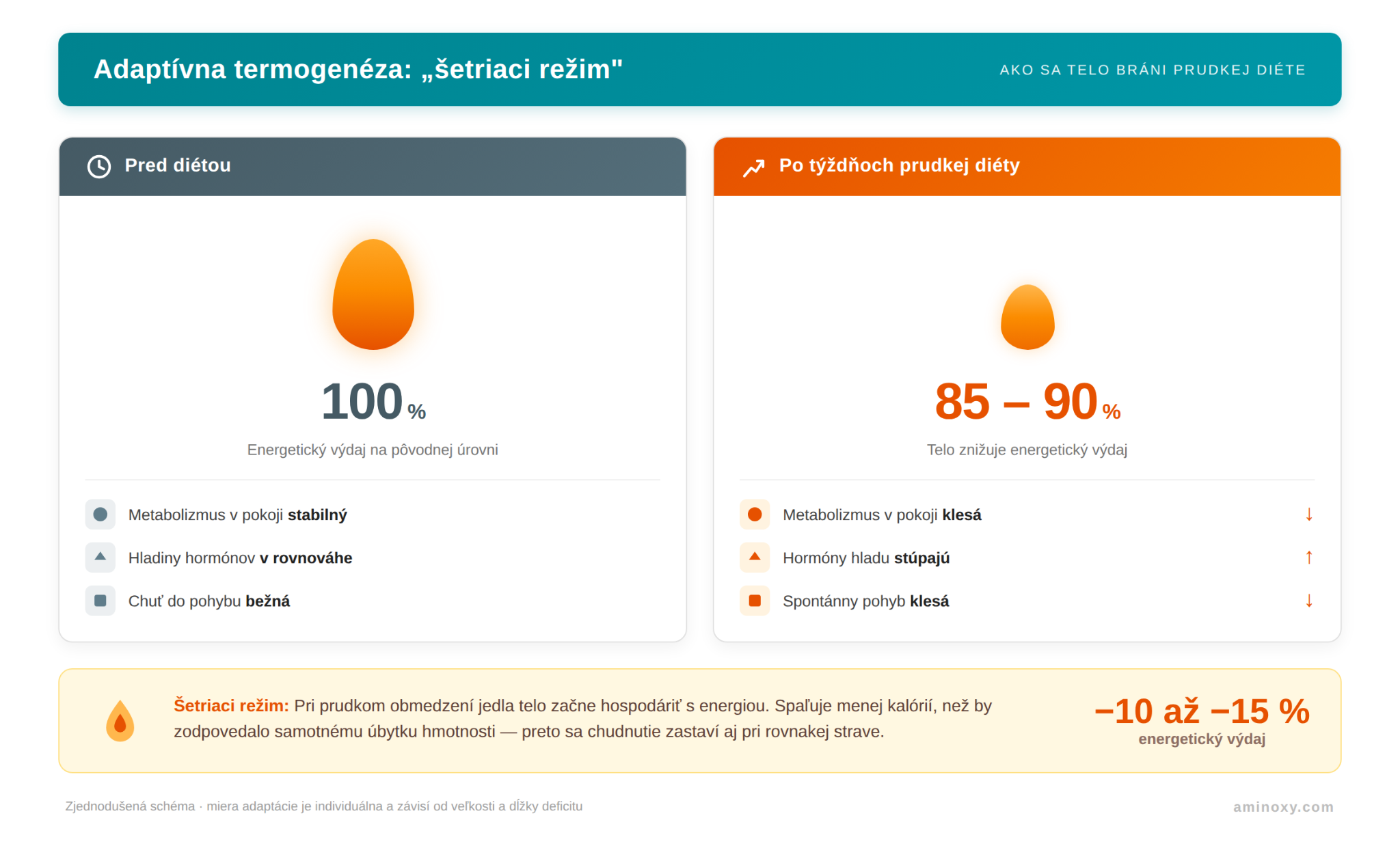
Adaptive thermogenesis is the technical term for the phenomenon whereby, in response to an energy deficit, the body reduces its energy expenditure by more than would be required simply to account for the weight loss itself. Put simply: the body ‘realises’ that less food is coming in and starts to manage its energy more efficiently. It’s a similar principle to turning down the thermostat in a house with high heating bills.
It works roughly as follows. The rate at which the body burns energy at rest is largely controlled by the thyroid gland — the body’s ‘metabolic regulator’. It does this via its hormone T3, which is the active, ‘switched-on’ form. When the body receives too little food, it begins to convert some of the T3 into its inactive form — reverse T3. You can think of reverse T3 as a key that looks the same but won’t turn in the lock: it circulates in the blood but no longer drives the metabolism. As a result, the body burns less energy and weight loss slows down noticeably — sometimes coming to a complete halt (Brainum J., Applied Metabolics Newsletter, August 2022).
Created using Claude AI (Anthropic).
It is precisely this period, when your weight remains unchanged for weeks on end despite eating and exercising just as you did before, that is commonly referred to as a weight-loss plateau (your weight loss has ‘stalled’). It is neither a disorder nor a sign that you are doing something wrong — it is the body’s defensive response to a lack of energy. This is precisely why experienced nutritionists point out that the body does not respond to a diet like a simple calculator — apart from calorie intake, hormones, including those from the thyroid gland, also play a role (Brainum J., Applied Metabolics Newsletter, March 2022).
Adaptive thermogenesis is also well documented in the scientific literature. It is one of the reasons why, after a diet, the body ‘remembers’ its original weight and actively tries to return to it (Müller MJ & Bosy-Westphal A., review article, Obesity, 2013, PMID: 23404923).
The key point is this: the more drastic the diet, the stronger the body’s defensive response. Trying to lose weight as quickly as possible therefore triggers precisely those mechanisms that make further weight loss more difficult. Conversely, a moderate calorie deficit triggers this response to a much lesser extent.
💡 The paradox of rapid weight loss: the more pressure you put on your body, the harder it fights back. A drastic diet suppresses the thyroid gland, slows down your metabolism and promotes muscle loss — thereby paving the way for weight regain. A slower pace bypasses this defence mechanism. |
Gallstones, electrolytes and cortisol during rapid weight loss
Very rapid weight loss is not only ineffective — it can also pose specific health risks:
Gallstones. Rapid weight loss is a known risk factor for the development of gallstones. During rapid weight loss, the composition of bile changes and the gallbladder does not empty as frequently, which promotes stone formation. According to the scientific literature, the risk is more pronounced with very low-calorie diets and rapid weight loss (Stokes CS et al., Clin Gastroenterol Hepatol, 2014, PMID: 24321208).
Loss of electrolytes. When food intake is drastically reduced, particularly on low-carbohydrate and highly restrictive diets, the body excretes minerals along with water: sodium, potassium, magnesium and calcium. Deficiencies in these minerals manifest as weakness, fatigue, muscle cramps and, in extreme cases, heart rhythm disturbances. It is precisely the loss of sodium that causes the typical feeling of exhaustion in the first few days of a strict diet (Brainum J., Applied Metabolics Newsletter, August 2022).
Tip: Magnesium deficiency is quite common even without dieting and manifests itself precisely as fatigue and cramps. If you’re interested in this topic in more detail, take a look at our article Are you deficient in magnesium? Symptoms, effects and the risk of overdose.
Cortisol. A strict diet puts the body under stress, and stress raises levels of the stress hormone cortisol. Persistently elevated cortisol has two unpleasant consequences for weight loss: it is catabolic, meaning it contributes to muscle breakdown, and it promotes water retention, which can mask actual fat loss. This is why the needle on the scales doesn’t budge, even though fat is being lost.
Summary
|
The yo-yo effect: why the weight comes back
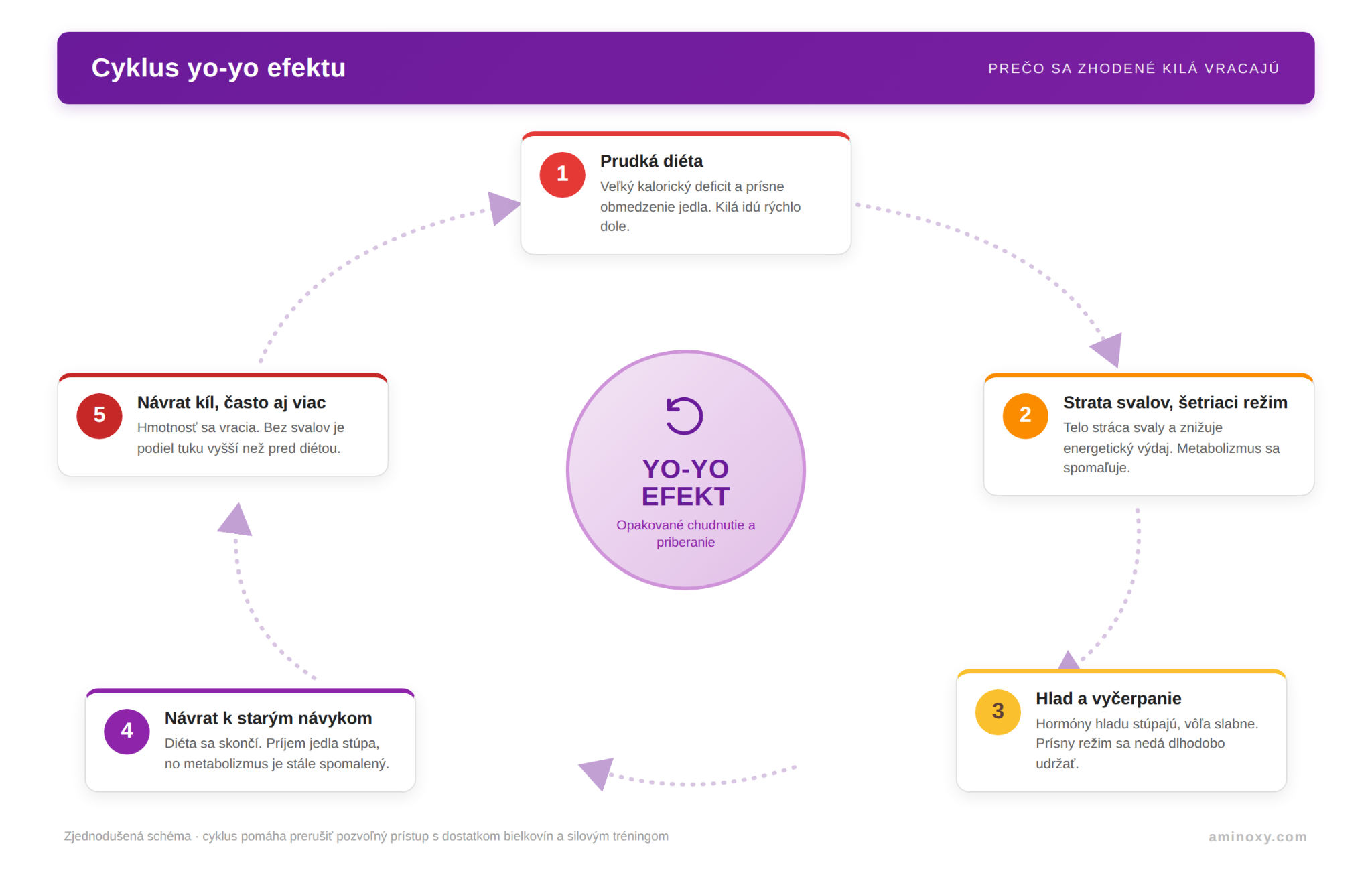
The yo-yo effect – that is, the repeated cycle of losing and regaining weight – is not a matter of weak willpower. It is, to a large extent, a logical consequence of rapid weight loss, which can be explained by the mechanisms described in the previous sections.
The cycle works as follows:
A drastic diet. A person adopts an extremely low calorie intake and loses weight rapidly. Much of the weight lost is water and muscle.
Slowed metabolism. The loss of muscle has reduced resting energy expenditure. Adaptive thermogenesis has reduced it even further. The body now burns noticeably fewer calories than before the diet.
A return to normal eating. Once the diet is over, the person returns to their original eating habits. However, their body now requires less energy than before — so the same diet that once merely maintained their weight now leads to weight gain.
Fat gain. The weight regained is predominantly fat, not lost muscle. Without targeted resistance training, muscle will not ‘grow back’ on its own.
A worse starting point. After one such cycle, a person often has a higher percentage of fat and less muscle than at the start — even at the same weight. Further weight loss is all the more difficult.
Created using Claude AI (Anthropic).
The result is a sobering statistic: according to evidence cited in the scientific literature, the vast majority of people who lose weight through a very rapid diet regain the lost weight within a year (Brainum J., Applied Metabolics Newsletter, August 2022).
How to break the cycle: The yo-yo effect occurs because a rapid diet breaks down muscle and slows down the metabolism. The solution is not a stricter diet, but a slower one: one that preserves muscle and does not trigger a strong defensive reaction from the body. The topic of mental health and one’s relationship with one’s own body is covered in a separate article in the series Mindset and Weight Loss: Self-Confidence, Stress and Your Relationship with Your Own Body.
How long does it take to lose 10, 20 or 30 kg
This is a question everyone with a specific goal asks themselves. Before you look at the table, it is essential to read the following warning — without it, the figures could lead to unrealistic expectations.
How should you interpret the table below? The figures given are a rough estimate derived from the maths of calorie deficit, not a guarantee. The actual rate of weight loss is highly individual and depends on many factors: starting weight and body fat percentage, gender, age, hormonal status, level of physical activity, sleep quality, genetics and history of previous diets. Furthermore, the rate naturally slows down as you lose weight: the closer you get to your target, the slower the kilos come off, and that’s normal. The table therefore does not show a single figure, but a range, and is based on actual fat loss, not initial water loss.
The following estimate is based on a rate of approximately 0.5 to 1 kg of fat loss per week (which corresponds to a mild to moderate calorie deficit and applies to most people on a sensibly planned diet):
Target (fat loss) | At a rate of ~0.5 kg/week | At a rate of ~1 kg/week | Realistic range |
10 kg | approximately 5 months | approximately 2.5 months | approx. 3–5 months |
20 kg | approximately 9–10 months | about 5 months | approx. 5–10 months |
30 kg | approximately 14 months | approximately 7 months | approximately 7–14 months and over |
A few notes on the table to help you interpret it correctly:
A faster rate of weight loss (approx. 1 kg per week) is realistically sustainable mainly for people with a higher starting weight. A slimmer person should stick to the lower end of the range, otherwise they risk losing muscle mass.
The lower and upper limits are not ‘better’ or ‘worse’ options. A slower rate often means more muscle is retained and the results are more sustainable.
The figures do not account for the natural slowdown towards the end. The last few kilograms almost always come off more slowly than the first; you should therefore aim for the upper limit of the range, particularly for larger weight loss targets.
The table is an illustration of the maths, not a prediction of your specific progress. In reality, it will be more of an irregular downward curve with plateaus than a straight line.
Summary
|
Conclusion — slow weight loss is faster in the long run
At first glance, this sounds like a contradiction, but it makes sense. A crash diet will produce an impressive figure on the scales within a few weeks, but a large proportion of the weight loss consists of water and muscle. The body then switches to survival mode, and in most cases the weight returns within a year. The actual time a person ‘gains’ from this kind of weight loss is often zero or negative, because after the yo-yo cycle they’re worse off than they were at the start.
Slow weight loss at a rate of 0.5–1 kg per week, on the other hand, preserves more muscle, does not trigger a strong defensive reaction from the body, and leads to a result that can be maintained. From the perspective of ‘how long will it take to stay slim for good?’, the slow approach is, paradoxically, the faster one. The right question, therefore, is not ‘how much weight will I lose in a month?’, but ‘what pace can I maintain so that I never have to worry about the weight I’ve lost again?’.

Aminoxy as a weight-loss partner
Supplements are not intended to replace exercise or patience. However, they can be a practical aid during periods when calorie intake is reduced: helping to ensure sufficient protein intake to protect muscle mass or to supplement micronutrients that are often lacking in restrictive diets. If you’re looking for supplements with transparent ingredients, take a look at the Sports Nutrition category.
⚠️ Important notice: The information in this article is intended solely for educational purposes. It does not constitute medical advice or a recommendation of specific substances. Low-calorie diets and significant weight loss in the context of health issues should be undertaken under medical supervision. Before taking any supplements, particularly if you have health issues or are taking medication, consult your doctor or pharmacist.
📚 This is the third article in the ‘How to Lose Weight Healthily’ series. Read also:
Part 4: What to eat when you want to lose weight: the basics of a weight-loss diet
Part 5: Hormones and weight loss: testosterone, IGF-1 and their impact on metabolism
Part 6: Psychology and weight loss: self-confidence, stress, and body image
List of sources
Müller MJ, Bosy-Westphal A. Adaptive thermogenesis with weight loss in humans. Obesity (Silver Spring). 2013;21(2):218-228. DOI: 10.1002/oby.20027 | PubMed
Stokes CS, Gluud LL, Casper M, Lammert F. Ursodeoxycholic acid and diets higher in fat prevent gallbladder stones during weight loss: a meta-analysis of randomised controlled trials. Clin Gastroenterol Hepatol. 2014;12(7):1090–1100. DOI: 10.1016/j.cgh.2013.11.031 | PubMed
Brainum J. Optimal Body Fat Loss for Bodybuilding and Fitness. Applied Metabolics Newsletter. August 2022. appliedmetabolics.com
Brainum J. The Science of Body Fat. Applied Metabolics Newsletter. November 2021. appliedmetabolics.com
Brainum J. A Calorie is a Calorie – or is it? Applied Metabolics Newsletter. March 2022. appliedmetabolics.com
Centres for Disease Control and Prevention (CDC). Losing Weight. cdc.gov
National Health Service (NHS). Start losing weight. nhs.uk